
(The things I wish someone had told me!)
I still remember the moment I pulled out of the airport car park in Pisa. It was a tiny blue Fiat Cinquecento, and it was 10 pm. Every single sign seemed to be pointing somewhere I didn’t recognise, and I had to join the main autostrada without causing mayhem. My hands were on the wheel, my maps were loaded, and I thought: what on earth am I doing?
But ten minutes later, I was winding through streets I never would have found on a tour bus on my way to Vicopisano. And by the end of the next day…
… I was completely hooked.
If you’re looking for honest driving in Italy tips, not the sanitised version but the real thing, you’re in the right place. This is one of the most rewarding ways to explore Italy. It gives you freedom, flexibility, and access to places that simply don’t exist on any tourist trail.
No train schedules.
No group itineraries.
Just you, the road, and whatever is waiting around the next bend.
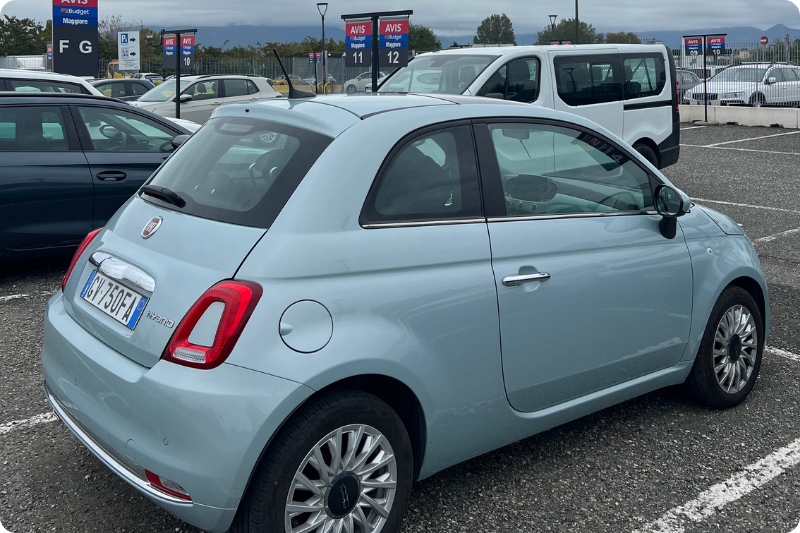
My favourite car to drive in Italy, a classic Fiat 500
What to Expect on Italian Roads
Italian roads are not one thing; they are many. Understanding the differences before you go will save you a lot of unnecessary anxiety on arrival.
In cities, particularly Rome, Naples and Milan, traffic can feel relentless and slightly chaotic. Scooters appear from nowhere, lanes are more of a suggestion than a rule, and the horn is used freely. The key is not to panic. Everyone around you knows what they are doing, even when it doesn’t look like it.
On the autostrade (motorways), driving is much like anywhere else in Europe. Signposting is clear, lanes are well-maintained, and speeds are consistent. You will need to pay tolls, but more about that later. And always keep right unless overtaking.
In the countryside, Tuscany, Umbria, and Abruzzo , roads open up and become genuinely beautiful. This is where an Italian road trip earns its reputation.
Rolling hills.
Cypress trees.
Vineyards stretching to the horizon.
Take it slowly and actually look.
In small towns and villages, streets can be one-car-wide, with ancient stone walls on both sides, and absolutely nowhere to go if someone comes the other way. Go slowly, use your mirrors, and don’t be embarrassed to reverse and let someone through. Locals do it every day, and they are generally patient with visitors.
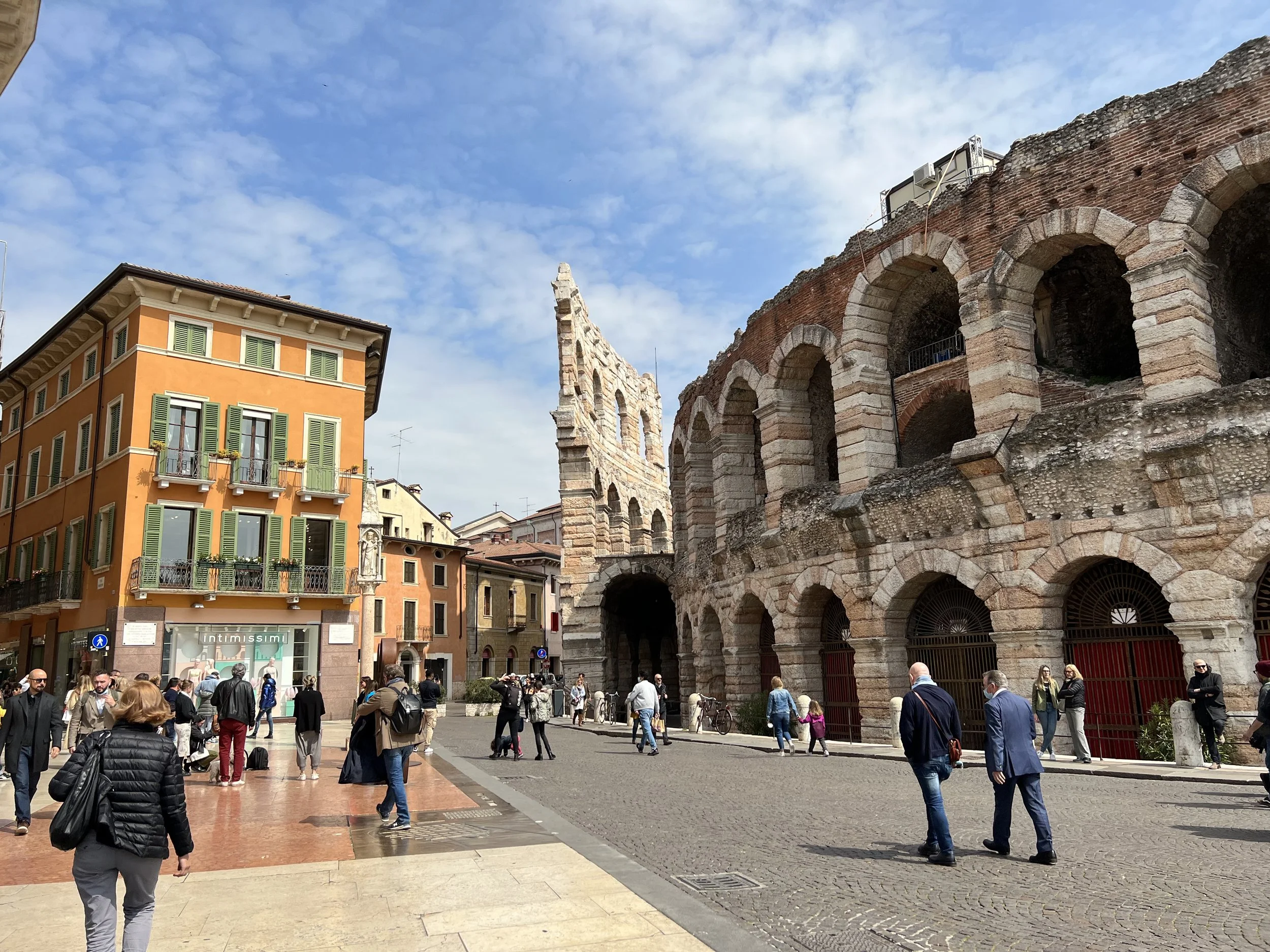
One thing worth knowing before you go: many historic town centres have a Zona Traffico Limitato (ZTL), a restricted traffic zone enforced by cameras.
Drive into one without a permit, and a fine will follow you home.
Google Maps will usually flag these zones, but as a rule of thumb, if it’s a historic town, it will undoubtedly have a ZTL.
Best apps for navigation:
Google Maps is excellent and reroutes around incidents in real time.
Waze is popular locally and provides strong real-time traffic alerts, as well as notifications about speed cameras and police on the side of the road.
So it’s worth having both downloaded before you leave.
Everything You Need to Know About Renting a Car in Italy
Don’t leave car hire to chance, especially in peak season: Prices rise sharply, and choice drops fast. Booking ahead, ideally a few weeks before you travel, gives you the best options and the best price (although I am guilty of not taking my own advice on this one!).
Good comparison sites for car hire in Italy include Rentalcars.com, Kayak, and AutoEurope. Check excess amounts carefully; the cheapest daily rate is not always the best deal.
Go small: A compact car is genuinely the right choice when you’re driving in Italy. Parking is tight, medieval streets were not built for SUVs, and a smaller car is far easier to manoeuvre when you inevitably end up on a road that’s slightly too narrow.
I almost always hire a Fiat Cinquecento. There is something about the way it fits Italy perfectly, small enough for the old streets, cheerful enough to match the mood, and modern enough to have Bluetooth, USB charging and air conditioning.
Automatic vs manual: If you are not fully confident in a manual in hilly, unfamiliar terrain, book an automatic. It removes a layer of stress, letting you focus on the road and the view.
Insurance: Check your travel insurance policy before you go. Many cover third-party, but not comprehensive.
It is usually worth paying for the hire company’s excess waiver, in case anything happens, you’re not facing a large unexpected bill (not what you want at all at the end of a holiday!). Read the small print. Don’t skip this. But if, like me, you are a frequent traveller, then I recommend investing in an annual excess policy. I use Worldwide Insure and always get the deluxe cover.
Credit or debit card: If you’re hiring a car in Italy, one of the biggest mistakes people make is assuming they can automatically pick up the vehicle using a debit card.
Always read the small print before booking.
While some rental companies do accept debit cards for the security deposit, many still require a credit card in the main driver’s name, even if you’ve already paid online. Turning up without the correct card can lead to huge extra charges, limited insurance options, or, in some cases, being refused the car altogether. It’s one of those small travel details that can completely derail the start of a trip, so it’s worth double-checking the payment and deposit policy carefully before you fly.
Fuel type: Confirm whether your hire car takes petrol or diesel before you fill up. It sounds obvious. It is an easy mistake. And it is an expensive one to fix.
Could this be the best spot to park a car?
Italian Driving Rules You Actually Need to Know
Italian road rules follow standard European practice in many ways, but there are specifics worth knowing before you set off, particularly if you’re used to driving in the UK.
Speed limits: 50 km/h in built-up areas, 90 km/h on rural roads, 110 km/h on dual carriageways, 130 km/h on motorways. Limits drop in wet weather. Speed cameras are frequent, and fines come to your home address (sometimes up to a year later!).
Seat belts: Compulsory for all passengers, front and back.
Mobile phones: Illegal to hold while driving. Hands-free only. Fines are significant.
Drink driving: The legal limit is 0.05% BAC, lower than the UK’s 0.08%. If you are driving, don’t drink. Simple.
Headlights: Must be on at all times outside built-up areas, including during the day.
Priority rules: At unmarked junctions, give way to traffic from the right. On roundabouts, traffic already on the roundabout has priority (the opposite of what some countries do).
Motorway tolls (pedaggi): Italy’s toll network is extensive. Pay by card or cash at booths. Some lanes use Telepass; your hire company can tell you if your vehicle has it. Budget for tolls when planning your trip.
ZTL zones: I mentioned before, but worth repeating. Do not drive into a ZTL without checking. The camera catches you, the fine will be on your doorstep when you get home, and your hire company may add an admin fee on top.
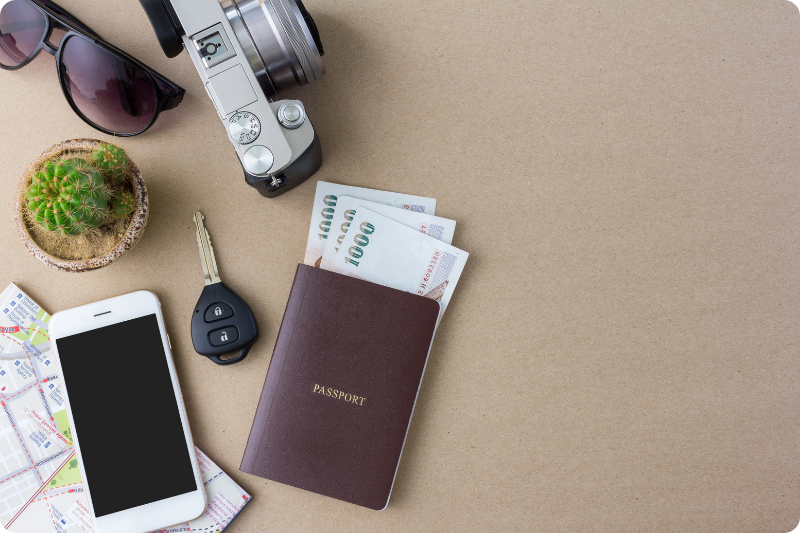
Keep these in your car at all times: Driving licence, passport or ID, car hire agreement, and proof of insurance. Digital copies on your phone are a sensible backup.
The Best Scenic Drives in Italy (And Why You Need a Car to Do Them)
This is the part I love most.
Because a solo road trip in Italy is not really about the driving, it’s about what the driving makes possible.
Tuscany is the classic for a reason. The Val d’Orcia, the road between Pienza and Montalcino, is one of the most photographed stretches of road in the world. Cypress-lined lanes, terracotta hill towns, vineyards as far as you can see.
Drive it slowly.
Stop often.
Bring a good picnic and no agenda.
One of my favourite driving routes in Italy (the guide is in my shop) had to be the journey from Panicale, across the quieter back roads of Umbria, stopping at beautiful, hidden towns like Ascoli Piceno in Marche and Civitella del Tronto, before winding down to Pianella in Abruzzo. It’s the kind of drive that reminds me why I’ll always choose the slower road in Italy.
The scenery shifts from rolling hills and olive groves to dramatic mountain landscapes, medieval hill towns and winding roads where you can drive for miles without seeing another tourist. It feels raw, cinematic and completely authentic. One of those routes where the journey becomes just as memorable as the destination.
Whatever route you choose, leave space in your days.
The best discoveries in Italy are always accidental. A sign for a village you’ve never heard of. A track that looks like it might lead somewhere. A view that makes you pull over for twenty minutes and just sit with it.
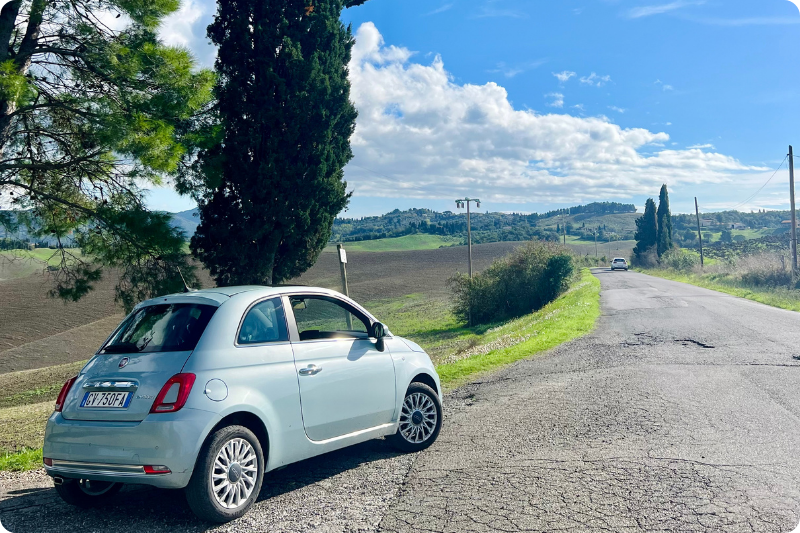
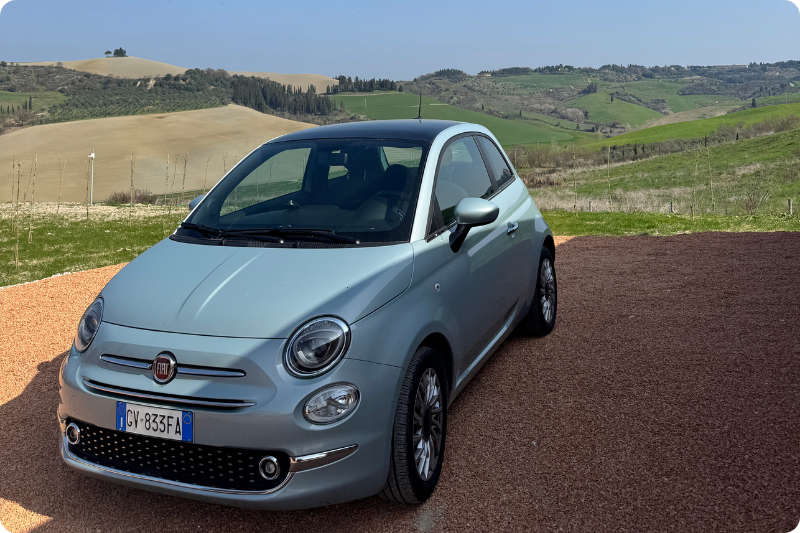
A great car, and an even better Tuscan view
How to Make Solo Driving in Italy Work (Especially If You’re Going Alone for the First Time)
Solo driving in Italy is, genuinely, one of the most liberating things I have ever done.
You stop when you want.
You take the longer road because it’s more beautiful.
You sit in a village square for two hours because the coffee is perfect, the light is golden, and nobody needs anything from you.
It is entirely, wonderfully yours.
And, here is what makes it work, practically and emotionally:
Hire a small car (the Cinquecento is my answer every time): I have already covered this, but it's worth saying again with feeling. A small car is not just a practical decision in Italy; it is the right one. I hire a Fiat Cinquecento almost every time I go. It fits the streets, it fits the mood, and honestly... It makes me smile every time I get in. That matters when you are driving solo somewhere new.
Keep your maps running: Have Google Maps or Maps.me open and running at all times, not just for directions, but to track speed limit changes. Download your route offline before you set off so you’re not dependent on data in rural areas. Maps.me works beautifully offline, and it’s free.
Plan your stops, not just your route: Know roughly where you’re stopping for coffee, lunch, fuel and the night. You don’t need to be rigid, but having loose anchors means you’re not making tired decisions on an unfamiliar road at 6 pm.
The two-hour rule: Limit driving to no more than two hours without a break. Tiredness on unfamiliar roads is a genuine risk, and if you have ADHD, long stretches of motorway can be harder to sustain focus on than you’d expect.
Get out.
Stretch.
Get a coffee.
Walk somewhere.
Italy has no shortage of beautiful places to pause, make the stops part of the experience, not an interruption to it.
Keep your tank topped up: As soon as you hit a quarter tank, refuel. Rural stretches can be long, and petrol stations are infrequent. Running low while lost in the Sibillini Mountains is not the adventure you want. Google Maps reliably shows nearby fuel stations; use it.
Pack a car kit: Keep these in your car, every single day:
• Water, at least 1.5 litres.
• Proper snacks, not just crisps.
• A light blanket or large scarf.
• A portable phone charger / power bank.
• A paper map of the region as backup.
• Sunscreen, Italian sun through a car window is no joke.
• Your documents in an easy-to-reach place.
Share your location: Before each driving day, message someone at home with your route and destination. Use WhatsApp’s live location feature, or just send a voice note saying where you’re headed. Thirty seconds. Peace of mind for your family or firends.
Trust yourself: This is the most important tip on the list. You have done harder things than driving in a new country.
You will make mistakes.
A wrong turn.
A parking attempt that needs three goes.
A junction that confuses you.
That is not failure. That is driving.
Every driver, everywhere, has those moments every day. You are not less capable for having them. You are just learning somewhere new.
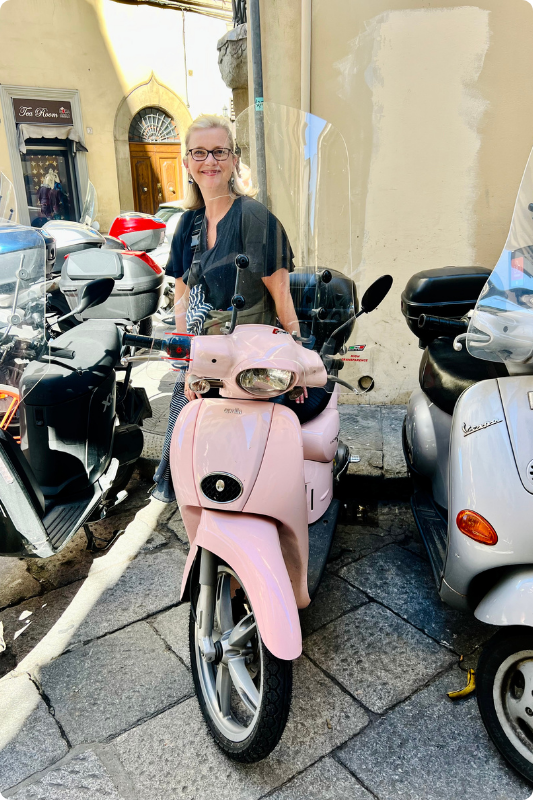
I found the perfect scooter… if I ever get tired of my little Fiat 500.
Practical Things Nobody Tells You (But You Really Need to Know)
How does parking work in Italy?
Look at the kerb markings.
White lines = free parking.
Blue lines = paid parking by ticket from a nearby machine (pagamento).
Yellow lines = reserved spaces for residents or disabled badge holders; do not park here.
In city centres and historic towns, look for a parcheggio (car park). Many centres now have park-and-ride systems on the outskirts; use them.
It is genuinely easier than navigating to the centre itself. EasyPark is also useful for finding and paying for parking on the go.
What fuel do I need for my hire car in Italy?
Confirm before you leave the car park. At Italian petrol stations: Benzina = petrol, Gasolio = diesel, GPL = LPG. Most stations outside cities are self-service; insert your card or cash first, then pump. Double-check the fuel type every single time!
Is it safe to drive in Italy alone as a woman?
Yes, genuinely. Italy is a safe country to drive solo, and the freedom it gives you is worth any initial nerves. The practical things that keep you safe are the same as anywhere: tell someone your route, keep your phone charged, stay topped up on fuel, and trust your instincts if something feels off.
I’ve only ever had one bad experience driving in Italy, and that was when I was stopped just outside a rural town in Tuscany by the local traffic police. They tried to claim I was driving without a seatbelt, which would have meant a hefty fine. I held my nerve, and with the help of google translate managed to prove that the car i was driving at the time won't even function if you’re not wearing a seatbelt! I think they were just bored and needed to fill their ticket quota for the day.
What do I do if something goes wrong on the road?
Stay calm.
Pull over somewhere safe.
Hazard lights on.
If there’s been an accident, don’t move the cars until the police arrive unless they’re causing a hazard. Photograph everything: the scene, other vehicles, road signs, and any damage to your car. Call your hire company’s emergency line first, then your insurer.
Emergency numbers to save before you travel:
112, European emergency number (police, ambulance, fire)
803 116, ACI (Italian Automobile Club) roadside assistance. Ask your hiring company if this is included.
Your hire company’s 24-hour emergency number. Get this before you leave the car park
What’s the weather like for driving in Italy?
Summers are hot, and the sun through a car window is intense. Park in shade wherever you can, use a windscreen sunshield, and never leave anything heat-sensitive in the car, such as passports, medication, or bank cards. In the mountains, conditions change quickly regardless of season. Check before you go: AccuWeather gives reliable regional Italian forecasts.
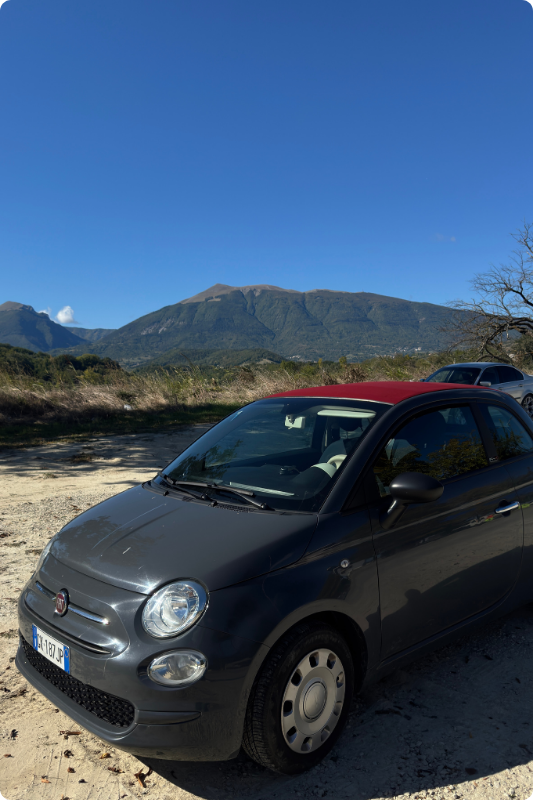
The Fiat 500 does come in other colours, and always looks lovely in front of a spectacular view
One Last Thing
When I think back to that first drive out of Pisa, the nerves, the unfamiliar roads, the slightly ridiculous confidence I was pretending to have, I feel something close to gratitude.
Because getting behind that wheel changed how I travel.
It opened up a version of Italy that most people never see.
That version of Italy is waiting for you.
Slower, quieter, more personal.
The road that takes twenty minutes longer, but is so beautiful you don’t mind at all.
These driving-in-Italy tips are everything I wish someone had handed me before that first day. But the truth is: you could read a hundred guides and still feel nervous when you pull out of that car park. That’s okay. The nerves are part of it. And so is the moment, about ten minutes later, when they disappear.
And if you have questions, or just want a bit of reassurance from someone who has been exactly where you are, drop me a message. I promise, you can do this.
Baci,
Beara x